


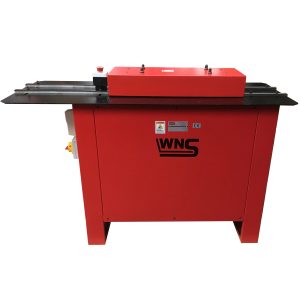
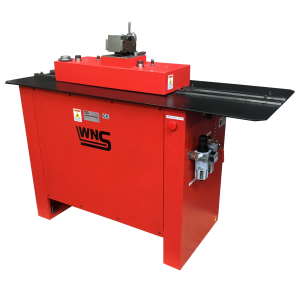

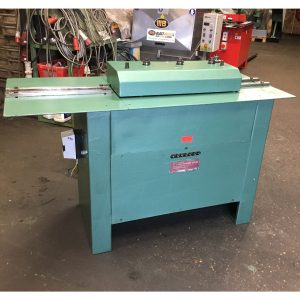
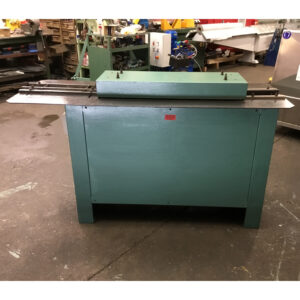


Looking for a Pittsburgh lock machine? Whether you're tooling up a new ductwork shop or replacing a worn-out lockformer, the right rollforming machine is the heart of any sheet-metal fabrication line. This guide walks through how Pittsburgh lock rollformers work, the difference between gauges and seam types, and which machine in the W. Neal Services range fits your fabrication.
The seam that built modern ductwork
What is a Pittsburgh Lock?
The Pittsburgh lock is the most widely used longitudinal seam in rectangular HVAC ductwork. A Pittsburgh lock rollformer forms a deep pocket — the "Pittsburgh" — along one edge of the sheet. The mating edge, carrying a small flange, slides into that pocket, and the protruding lip is then hammered or power-flanged over to lock the joint tight. The result is a strong, airtight, self-aligning seam that needs no welding and very little hand finishing.
Because the Pittsburgh lock seam is fast to make and consistent across every length of duct, it became the standard for sheet-metal duct fabrication worldwide. A single Pittsburgh lockformer can profile hundreds of metres of duct in a day, which is why it remains the first machine most fabrication shops invest in.
Step by step
How to close a Pittsburgh lock
Once the Pittsburgh seam is rollformed and the duct is assembled, the joint is locked by turning the pocket lip over the inserted edge. Here is how the seam is closed on the shop floor — and where a power flanger saves hours of hand work.
1
Assemble the seam
Slide the flanged edge of one panel fully into the Pittsburgh pocket of the mating panel, along the entire length of the joint.
2
Fold the duct square
Form the duct to shape so the seam pulls up tight and the pocket lip stands proud, ready to be turned.
3
Turn the lip over
Close the protruding pocket lip down onto the inserted edge — by hand with a mallet and hatchet, or far faster with a power flanger or seam closer.
4
Work the full length
Close the seam evenly from end to end so the locked edge sits flat, continuous and gap-free.
5
Check & dress
Run along the finished seam to confirm it is tight and airtight, dressing down any high spots.
Machines & tools used to close the seam
The seam can also be closed with a dedicated seam closer rather than by hand. WNS supplies the Pittsburgh Lock Seam Closer/Locker (SC10/SC12) — a powered closer that automatically adjusts to material thickness, covering 0.5–1.0mm (SC10) or 0.75–1.2mm (SC12) mild steel — and the 18swg Pittsburgh Lock Air Closing Hammer (AH18), a pneumatic hammer for hand-guided closing up to 1.2mm mild steel. Elsewhere in the industry, similar work is done by the Iowa Precision Whisper-Loc, an automated machine that seams from top and bottom to the middle and closes a Pittsburgh seam in under six seconds without hammering; the WUKO Pittsburgh Seam Closer 1004, a portable Austrian-made tool for 5/16", 3/8" or 1/2" seams on straight and curved duct; and the Trumpf TruTool F-series (F 300, F 300 with 1700W motor, F 301, F 125 and F 140), a range of handheld seam lockers covering roughly 0.45mm–1.4mm in mild steel and stainless, each model matched to a different sheet-thickness range.
Clearing up the jargon
Rollformer vs Lockformer — what's the difference?
In everyday shop talk the words are used interchangeably. A rollformer is any machine that shapes a continuous profile into sheet metal by passing it through a train of forming rolls. A lockformer is simply a rollformer tooled to produce a locking duct seam — most often a Pittsburgh lock or a button-punch snap lock. So every lockformer is a rollformer, but not every rollformer is a lockformer.
You'll also hear the trade nickname "tin knocker" for the fabricators who run these machines. Whatever you call it, when buyers search for a lockformer machine for sale, a Pittsburgh lock former or a roll former machine, they're almost always after the same thing: a reliable machine to form the Pittsburgh seam on duct.
A century of seams
The history of Pittsburgh lock rollformers & lockformers
The Pittsburgh lock has been holding ductwork together for well over a century. The machines that form it — today's Pittsburgh lock rollformers and lockformers — evolved from simple hand tools into powered and fully automated production lines, yet the seam itself has barely changed.

Late 1800s
The Pittsburgh seam is born
In the sheet-metal shops of America's industrial cities, fabricators developed a self-locking edge seam for joining flat sheet into rectangular duct and casings. It took its name from Pittsburgh, the heart of the era's steel industry, and was formed entirely by hand on brakes and folders.
Early 1900s
From hand tools to forming rolls
As demand for ventilation and ductwork grew, the repetitive job of forming the seam by hand was mechanised. Early rollforming machines passed the sheet edge through a train of profiled rolls, creating the Pittsburgh pocket in a single pass and bringing a consistency the hand-formed seam could never match.
1940s–1950s
The powered lockformer
Dedicated lockforming machines added geared, motor-driven rolls, so the operator simply fed and guided the sheet. The post-war air-conditioning boom turned ductwork into mass production, and the powered Pittsburgh lock rollformer became the cornerstone of the modern sheet-metal shop.
1960s–1980s
A workshop staple worldwide
The Pittsburgh lock rollformer settled into shops around the world. Double extended shaft machines let one frame carry two roll sets and run multiple profiles, while power flangers mechanised the final step of closing the seam — speeding up the whole duct-making line.
1990s–2000s
Automation arrives
Coil lines, automatic feed, pneumatic forming and CNC duct lines folded the Pittsburgh seam into fully automated production. Remarkably, the seam profile itself stayed almost unchanged — proof of how well the original design worked.
Today
British-built, carrying it forward
W. Neal Services manufactures Pittsburgh lock rollformers, lockformers and power flangers in the UK, supplying HVAC and fabrication shops with new, used and reconditioned machines, spare parts and service — continuing a craft more than a century in the making.
From the archive
What the old manufacturers' literature said
Vintage sales brochures from lockforming manufacturers describe the same seam in their own words — a record of how the Pittsburgh lock rollformer has been built and sold over the decades.
“The Pittsburgh lock, the most complex shape, is produced by inbuilt rolls mounted between the side plates and bearings. Sets of rolls for other locks and cleats, or slips, are mounted on the extended shafts, if necessary by changeover of rolls.”
Oliver — Lock Seamer Brochure
“The machine serves for the production of seams for door frames or ducts, as well as shapes for air conditioning plants. With standard forming rolls and a material thickness of 0.5–1.5mm, seaming operations are carried out in one single pass without resetting the machine.”
RAS — Roll Forming Machines Brochure
“The original heavy and light gauge machines for standard square duct Roll Forming. The 14, 16 and 18 gauge Pittsburgh Roll Forming machines have seven forming stations with two forming positions, while the Super Speed 20 and 22 models have five forming stations with two forming positions.”
MJ Allen — Roll Forming Machine Brochure
“CMZ Roll Formers and flangers are built with rugged external fabrications. The internal working (rolls, shafts, etc) are produced on CNC machining centres, and are rated up to machine tool standards, for accuracy and tolerance.”
CMZ — Roll Forming Machine Brochure
“It is using a large number of gear and large diameter roller wheel, this can help to strength the machine and improve the work efficiency, the "S" shape bone mouth roll round, can reach the top industry leading level.”
China Zhejiang Int'l Economic & Technical — Roll Forming Machine
“A machine for multifunction, it can complete the Pittsburgh Lock, single lock, standing lock, C shape insert and elbow Lock Forming... Because of the strength and workability in assembling duct work, Pittsburgh Lock is still used in industry today.”
Coorig — Roll Forming Machine Brochure
Manufacturers & suppliers
The W. Neal Services rollforming range
From single-profile Pittsburgh lockformers to double extended shaft machines that run two profiles at once, our range covers every stage of duct seam fabrication.
16swg · 1.6mm
16swg Pittsburgh Lock Rollformers
Our heaviest-duty lockformers, forming the Pittsburgh seam in steel up to 1.6mm — the workhorse of high-volume duct shops.
View machines →
18swg · 1.2mm
18swg Pittsburgh Lockformers
The all-round mixed-duty machine, balancing capacity and speed for general ductwork fabrication.
View machines →
20swg · 1.0mm
20swg Pittsburgh Lock Rollformers
Lighter, faster forming for high-speed rectangular and spiral duct runs.
View machines →
Two profiles, one machine
Double Extended Shaft Rollformers
Extended shafts carry two roll sets so a single machine runs two profiles — e.g. Pittsburgh plus S-cleat.
View machines →
Snap-together seam
Button Punch Snap Lock Rollformers
Form the self-locking button-punch snap lock seam for fast, hammer-free duct assembly.
View machines →
Close & connect
Power Flangers
Powered flanging machines that close the Pittsburgh lock and turn connection flanges on duct and sheet.
View machines →
For reference
Machines in the WNS range
16 · 18 · 20swg
Choosing the right gauge
In the UK, sheet thickness is given in SWG (Standard Wire Gauge) — the lower the number, the thicker the steel. Your rollformer must match the heaviest material you intend to run.
| Gauge | Thickness | Best for | WNS model |
|---|---|---|---|
| 16swg | 1.6 mm | Heavy-duty workshops, large rectangular duct, high volume | RF16 |
| 18swg | 1.2 mm | All-round mixed-duty ducting and general fabrication | RF18 / DE18 |
| 20swg | 1.0 mm | Lighter, high-speed duct runs and spiral work | RF20-FA |
Drive type
Manual, powered or pneumatic?
Manual
Hand-cranked rollformers suit low-volume shops, mobile work and tight budgets. No power supply needed, simple to maintain, and ideal as a back-up machine.
Most popular
Powered
A geared motor drives the rolls so you simply feed and guide the sheet. The standard choice for production duct shops — consistent output, less fatigue, far higher throughput.
Pneumatic
Air-driven models such as our RF16-PN add automatic feed and flanging for the fastest, most repeatable seam forming — perfect for high-volume, hands-free running.
New, used & reconditioned
Buying new vs used lockformers
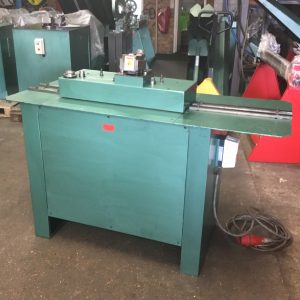
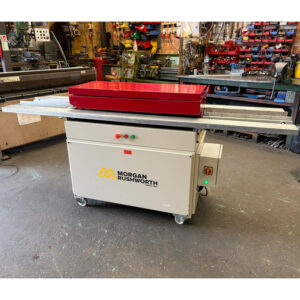
A brand-new machine gives you the latest tooling, a full warranty and the longest service life. But a used or reconditioned Pittsburgh lockformer can be the smart buy when budget matters or you need a second machine quickly. Every used machine we sell is inspected, refurbished where needed, and backed by the same UK parts and service as our new range.
Used & reconditioned examples
Where they're used
Applications & industries
HVAC Ductwork
Rectangular and spiral duct seam fabrication for heating, ventilation and air-conditioning installs.
Sheet Metal Fabrication
General fabrication shops forming locked seams, flanges and folds in mild and galvanised steel.
Ducting & Cladding
On-site and workshop manufacture of ducting, casings, plenums and architectural cladding.
Maintenance & Repair
In-house duct production for facilities, building services and refit contractors.
After the sale
Spare parts, service & machinery wanted
A rollformer is a long-term investment, and we keep yours running. We manufacture and stock rollformer spare parts, opening rolls and consumables, service and repair most makes of lockforming machine, and buy quality used machinery outright.
The WNS difference
Why choose W. Neal Services Ltd?
Buying a rollformer is a long-term decision, so it pays to buy from a specialist who builds, supplies and supports the machines — not just sells them.
Over 40 years in the industry
Four decades designing, building and servicing sheet-metal machinery means we know what works on the workshop floor — and how to keep it running.
Spare parts stocked
We manufacture and stock spare parts, opening rolls and consumables, so a worn roll or part never means weeks of downtime.
Extensive knowledge base
A specialist team that genuinely knows ductwork. Tell us what you fabricate and we will match the right gauge, seam and machine — no upselling.
Internationally recognised WNS brand
The Big Red Machines are known to fabricators across the UK, Europe and worldwide, with machinery supplied and shipped internationally.
Reconditioned machinery available
Fully checked used and reconditioned Pittsburgh lockformers, rollformers and power flangers — backed by the same UK parts and service as our new range.
UK manufacturing & service
British-built machines plus on-site and in-house service & repair for Lockformers, Rollformers, RAS Ductseamers, DuctZippers and more.
Know the terms
Lockforming glossary
Common questions
Pittsburgh lock machine FAQs
What is a Pittsburgh lock machine?
A Pittsburgh lock machine (or lockformer) is a rollforming machine that forms the Pittsburgh lock seam — the most common longitudinal joint in rectangular HVAC ductwork. Sheet metal is fed through forming rolls that create a pocket on one edge to receive and lock the mating edge.
What's the difference between a rollformer and a lockformer?
The terms are used interchangeably. A rollformer roll-forms a profile onto sheet metal; a lockformer is simply a rollformer set up to form a locking duct seam such as the Pittsburgh lock or button-punch snap lock.
Which gauge rollformer do I need — 16, 18 or 20swg?
Choose by the thickest material you fabricate. 16swg (1.6mm) is the heavy-duty workshop standard, 18swg (1.2mm) suits mixed-duty ducting, and 20swg (1.0mm) is ideal for lighter, high-speed duct work.
Do you sell used and reconditioned Pittsburgh lockformers?
Yes. We stock used and fully reconditioned Pittsburgh lock rollformers, double extended shaft rollformers and power flangers — all checked and backed by UK service and spare parts.
Do you supply spare parts and servicing?
Yes — we manufacture and stock rollformer spare parts, opening rolls and consumables, and offer service, repair and refurbishment for most makes of lockforming machine.
Do you ship rollformers to Europe and worldwide?
Yes. We supply Pittsburgh lock rollformers and lockforming machinery across the UK, Europe and worldwide. Contact our team for a delivered price.